| Friday, October 24, 2008 |
| Nikon Coolpix S210 (blue) |
With its supermodel-slim body and classy chassis--clad in jewel tones of brushed metallic blue, plum, bronze, and basic black--the Nikon Coolpix S210 will certainly make a style statement when you whip it out of whatever tiny pocket you've slipped it into. But as with its slightly more expensive and marginally slimmer-than-thou competitor, the Casio Exilim EX-S880, the performance and photo-quality trade-offs you make for high style and low price may not quite be worth it.  The S210 uses the typical Nikon menu scheme, though better implemented than in the annoying Coolpix S600. A Mode button pops you into selecting among auto, Hi ISO (auto ISO up to 1600, compared with ISO 800 for normal auto ISO), Scene, Voice recording, Movie, and Setup modes. Menu calls up frequently accessed shooting options: image resolution, white balance, ISO sensitivity (Auto plus manual 64 through 2000), and color effects. You'll also find the AF area mode options here, which include Center, Manual spot, Auto, and Face Priority, as well as the various drive-mode options: single, continuous, Best Shot Selector, Multi-shot 16 (16 successive shots in a single frame), Interval Timer, and Time-Lapse in movie-capture mode. The BSS can be quite useful--it shoots up to 10 photos as you hold the shutter down, then saves the sharpest of the bunch.  But you really don't want to shoot at higher than ISO 400 with this camera, so forget the high ISO mode. As with the S600, the face-priority AF is too slow, as well as too erratic, to take seriously, and as with most snapshot models, the auto area AF invariably picks the wrong subject. As usual, I recommend that you eschew all the fancy AF modes and instead use center AF, focus, and recompose. For selecting the appropriate subject, you're still faster than the camera. There's also D-Lighting, which can apply tonal corrections in-camera for those inevitable underexposed shots, but this feature works best on models that have better high-ISO performance; it unavoidably exacerbates noise. The camera lacks optical image stabilization, and electronic stabilizers are generally poor substitutes. Unfortunately, the S210's performance is fairly sluggish. It wakes up and shoots in a reasonable amount of time--2 seconds--but its normal single and sequential (not burst) shooting performance trails both competitors and what we consider generally acceptable. It takes 0.9 second to focus and shoot under optimal conditions and 1.5 seconds in suboptimal circumstances; most snapshot cameras have gotten those times closer to 0.5 and 1 second, respectively. Firing two shots in a row takes 3.1 seconds, 3.4 seconds with flash, both of which are close to bottom-of-class performance. Oddly, continuous-shooting performance does OK, bursting at a rate of about 1.5 frames per second. The LCD fares pretty well. At 2.5 inches, it's a bit small for a fashionista camera and a tiny bit smaller than the EX-S880's, but about as big as you could fit on this model and typical for the price. If you boost the brightness, it's adequately viewable in direct sunlight, though that will eat into the camera's 220 shot battery life (CIPA rating). But it's got a nice, wide viewing angle that delivers a good overhead shooting and group viewing experience.
Source:http://reviews.cnet.com/digital-cameras/nikon-coolpix-s210-blue/4505-6501_7-32854267.html?tag=mncol;lstLabels: Camera Reviews, Nikon Camera |
posted by Raisa @ 12:48 AM  |
|
|
|
| Tuesday, July 29, 2008 |
| Nikon S200 (7.1Mega Pixel) |
 One of the tiniest Nikon Coolpix cameras to date, the 7.1 megapixel Nikon Coolpix S200 is a small but stylish point-and-shoot camera. Equipped with a telescoping 3x optical zoom lens, the Nikon S200 offers a moderate 35mm-equivalent focal range of 38-114mm that is extendable by a 4x digital zoom. A 2.5-inch LCD with 153,000 pixel resolution is the only means of composing since, like most sub-compact digital cameras, the Nikon S200 does not have an optical viewfinder.
More information
Max resolution - 3072 x 2304
Low resolution - 2592 x 1944, 2048 x 1536, 1024 x 768, 640 x 480
Image ratio w:h - 4:3
Effective pixels - 7.1 million
Sensor photo detectors - 7.4 million
Sensor size - 1/2.5 " (5.75 x 4.31 mm, 0.24 cm²)
Pixel density - 29 MP/cm²
Sensor type - CCD
Sensor manufacturer - Unknown
ISO rating - Auto (50-800), 50, 100, 200, 400, 800, 1000
Zoom wide (W) - 38 mm
Zoom tele (T) - 114 mm (3 x)
Digital zoom - Yes, 4x
Image stabilization - Yes, Lens
help Auto Focus - Yes
Manual Focus - Yes
Auto focus type - Unknown
Normal focus range - 60 cm
Macro focus range - 10 cm
White balance override - 5 positions, manual preset
Aperture range - F3.1 - F5.9
Min shutter - Unknown
Max shutter - Unknown
Built-in Flash - Yes
Flash guide no. - 5.4 m (17.7 ft)
External flash - No
Flash modes - Auto, Red-Eye reduction, Off, On, Slow sync
Exposure compensation - -2 to +2 EV in 1/3 EV steps
Continuous Drive - Yes
Movie Clips - Yes, 640 x 480, 30 fps, 320 x 240 30/15 fps, 160 x 120, 15 fps
Remote control - No
Self-timer - 10 sec
Timelapse recording - No
Orientation sensor - No
Storage types - SD/SDHC card, Internal
Storage included - 20 MB Internal
Uncompressed format - No
Compressed format - JPEG (EXIF 2.2)
Quality Levels - High, Normal
Viewfinder - No
LCD - 2.5 "
LCD Pixels - 115,000
Video out - Yes
USB - Yes
Firewire (IEEE 1394) - No
Battery / Charger - Yes
Battery - Nikon EN-EL10 Lithium-Ion & charger
Weight (inc. batteries) - 165 g (5.8 oz)
Dimensions - 92 x 57 x 19 mm (3.6 x 2.2 x 0.7 in)
Notes -Labels: Camera Reviews, Nikon Camera |
| posted by Raisa @ 11:57 PM |
|
|
|
| Thursday, July 17, 2008 |
| The world of images is a beautiful place, just walk into it! |

The modern day market is never short of quality products and a new product is almost on the verge of introduction as soon as the last one has seen the light of the market world. This continuing trend has been the reason for numerous product innovations and the world of digital camera is not left untouched by this universal phenomena.
The history of digital camera is quite amazing in itself. The camera market saw early models in the late 1980s but they were not good when it came to performance, price and image quality. However, in the mid-1990s, digital cameras were introduced for the technology-gadget fanatics but these too were slightly below the expected levels. It was only in the late 1990s that power-packed cameras started to come out of the factories. This led to a steady decline in the sales of film cameras and a significant growth in the sales of their digital counterparts.
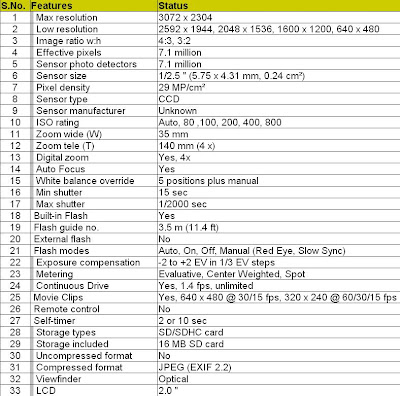
Let us have a close look at the advantages offered by the digital cameras of today. These cameras have become affordable and their memory cards are now inexpensive. In addition to that, the processing of digitally captured images is also very cost effective. These cameras also offer the option to reject and delete the blur and unwanted images and print only those pictures that come good.
The instant, natural and responsive feedback offered by the digicams is exceptionally high when someone compares them to their film camera counterparts. Most of the latest and cheap digital cameras can click high-quality images even in low light conditions. A camera based on the advanced digital technology allows the users to alter the levels of sensitivity to respond to the prevailing light conditions with an easy adjustment of the ISO settings. These cameras are sleek, space-conscious and offer a high degree of portability, flexibility and deliver seamless image solutions right from the word "Go."Labels: Camera Reviews |
| posted by Raisa @ 5:02 AM |
|
|
|
| Wednesday, April 30, 2008 |
| Sony Cyber-shot DSC-H3 - Digital Camera Review |

The Sony DSC-H3 is the latest addition to the company's Cyber-shot H-series, forming a new entry point to the line beneath the existing DSC-H7 and DSC-H9 models.
The Sony H3 combines eight megapixel resolution with a 2.5-inch LCD display and a powerful Carl Zeiss Vario-Tessar branded 10x optical zoom lens, offering a range from a rather tight 38mm wide-angle to a very useful 380mm telephoto. As with previous H-series models, the DSC-H3's lens incorporates Sony's Super Steady Shot optical image stabilization to minimize blur caused by camera shake -- an essential feature for such a long zoom when not using a tripod. Other Sony H3 features include ISO sensitivity to a maximum of ISO 3,200; an advanced sports shooting mode which combines predictive continuous autofocus with high shutter speeds; a Memory Stick DUO/PRO DUO card slot and 31MB of built in memory; and power from a proprietary lithium-ion rechargeable battery. The DSC-H3 also offers high definition component video output via an optional proprietary cable.
The H3 includes Sony's face detection technology, which is linked not only to the camera's autoexposure and autofocus systems as in most similar systems, but also to white balance and flash metering as well -- allowing the camera to ensure proper flash exposure and pleasing flesh tones. Also, the Sony H3 includes Sony's Bionz image processor -- first seen in the company's Alpha dSLRs -- which the company says will offer improved image quality, faster response times, and better battery life in its compact cameras.
The Sony Cyber-shot DSC-H3 ships in black from early September 2007 and is priced at U.S.$300.
Sony H3 User Report
Intro. Sony's H-Series is the company's stable of long zoom thoroughbreds. The H1 was launched in early 2005 with the H2 and H5 following in Spring 2006. When I reviewed the H5 last year, I complained that it was awkward to use but took marvelous pictures.

Closed. The included lens cap is covering the lens.
Extended. The lens extended and ready for action.
The 2007 H-Series is completely redesigned. The Sony H3 is probably the most radical member of the series. Gone is the electronic viewfinder and the LCD has shrunk from 3.0 to 2.5 inches. That, along with a move to lithium-ion power from AA power has made the Sony H3 a much smaller camera.
That's good because you'll want to take the Sony H3 with you everywhere, particularly to sporting events.
A long zoom is essential for shooting sports. Turn the television to any sporting event and you'll see the pros shooting with what look like telescopes. Even from the sidelines of a grade school soccer match, though, you need a long zoom. The Sony H3 has just the reach you need. Its reach at the equivalent of 380mm is serious fun, and you can double that at full resolution and get a crazy 51x zoom if you'll settle for 640x480-pixel image.
Rear View. The 2.5-inch LCD with simple controls to the right.
Focus is also an issue in trying to track fast-moving athletes. The Sony H3's Sports mode uses a combination of continuous focus and predictive focusing to set focus where the action is, according to Sony. And, of course, the Sony H3 can select a shutter speed as high as 1/2,000 second to stop the action.

This little sibling to the H7 and H9 is great for shooting outdoors, period. And you won't have to take out a loan to acquire the Sony H3, either.
Grip. Very comfortable grip for such a small camera.
Look and Feel. While the Sony H3's design is inspired by the mini-SLR school, it's flatter on top and the grip is more of an add-on. That makes it sort of an odd duck to look at but comfortable in the hand.
I liked the both the grip and the heft of the Sony H3. The grip actually has a little breathing room between it and the lens, making it comfortable to hold. And the Sony H3 weighs a bit less than average for its class, so you won't get tired holding it (sporting events require a lot of holding and just a little shooting). It comes with a nice shoulder strap but you should find a bag to transport it.
Lens Shade. You attach it to the included adapter that screws onto the body. It makes the little Sony H3 a lot bigger.

Also included with the Sony H3 is a lens adapter and a lens hood to shade the lens when shooting into the sun. The lens adapter is required for the optional 0.7x wide angle converter and the 1.7x telephoto converter. You also need the lens adapter to attach the hood and the combination blocks the light from the Sony H3's flash. Not a big deal indoors, since you rarely need a hood when shooting with flash, but good to know when shooting outdoors with fill flash. The adapter also accepts 58mm screw-on filters.
Top Panel. The Sony H3's Power button is flush with the top panel behind the large Shutter button. The Mode dial occupies the back corner.
The Sony H3's controls are really minimal and easy to find. So you won't have to remember much from one session to another. On the top panel, the small but functional Power button sits flush behind the large Shutter button. A Mode dial occupies the rear corner of the top panel, making your options easy to find.

Controls. Zoom lever and navigator are joined by the Menu and Home buttons.
On the Sony H3's back panel, zoom is controlled by a rocker switch and the four-way navigator with arrow buttons that also control what you see on the display, the flash mode, Macro mode and the self-timer sits in the corner to the right of the Menu and Home buttons that give you access to the LCD menu options.
Right behind the popup flash is the Playback button. You can press this to turn on the Sony H3 without extending the lens, but you have to hit the Power button to turn it off.
Charger. Very compact. The prongs swivel out to connect and back for travel.
You do all your framing with the Sony H3's 2.5-inch LCD. With just 115,000 pixels, text isn't displayed very smoothly, but it works fine. There's no optical viewfinder and no electronic viewfinder either, but that just helps hold the cost down.
The Sony H3's LCD, like all LCDs, is a very accurate viewfinder, however. At wide angle it shows 102.6 percent of the scene. At telephoto it shows exactly 100 percent.
Despite its shiny surface, I was able to use the Sony H3's LCD in direct sun, something I can't say about many LCDs these days.
Source:http://www.imaging-resource.com/PRODS/H3/H3A.HTM
by Mike Pasini
----------------------------------------------------------------------------------
Reviewed by: Philip Ryan,CNET.com
The good: Has 10x optical zoom lens; small size; optical image stabilization; face detection.
The bad: Noisy images at higher ISOs; no place to put your thumb.
The bottom line: If you don't like electronic viewfinders, but want a superzoom, this Sony packs a 10x zoom lens and 8 megapixels into a tiny package, but image quality at higher ISOs is a bit lacking.
If you're reading this, then you probably already know that there are a lot of different kinds of cameras in the world. This year, we saw the birth of a new variation with the advent of superzooms that don't have electronic viewfinders, such as the Sony Cyber-shot DSC-H3 I'll be writing about here. The upside is that the cameras can be smaller than their EVF-laden counterparts, and if you despise peering into a tiny hole at an LCD while framing your shots, then you'll welcome this evolution. However, if you've discovered as I have that an EVF can come in handy when shooting certain subjects (I like using one when shooting baseball batters), then you might want to check out one of Sony's other superzooms, such as the DSC-H7 or DSC-H9.
While the H3's small body design (for a superzoom) is definitely handy when trying to fit it in a bag or jacket pocket, it leaves few options for the button layout. Sony basically had to put the zoom rocker smack in the middle of where your thumb should naturally rest, which might seem good at first, but I ended up accidentally nudging it often when shooting, throwing off my zoom setting and messing up the framing of my shot. If Sony would've moved the shutter button a little to the left and the mode dial forward, the zoom rocker could've been moved farther right and given room for your thumb. However, as the body design goes, that's the biggest flaw. The grip, though small, is effective--curl your middle finger over the top of the grip, and the rest of your fingers fall nicely into place, though it does leave your pinky dangling, which always irks me. It seems as though camera makers have begun to despise the pinky finger. Most entry-level dSLRs and almost all superzooms have grips that can't fit a pinky.
Dominating the front of the camera is a Carl Zeiss-branded Vario-Tessar 10x optical 38-380mm equivalent f/3.5-4.4 zoom lens, which feeds light to an 8.1-megapixel CCD sensor. Around back you'll find a 2.5-inch, 115,000-pixel LCD. Caffeine addicts should be pleased to know that the H3 includes Sony's Super Steady Shot optical image stabilization to help compensate for hand shake. In case the built-in lens isn't wide or long enough for you, Sony offers both a 0.7x-wide angle converter (VCL-DH0758) and a 1.7x telephoto converter (VCL-DH1758). The necessary adapter ships with the camera and can also accept 58mm screw-on filters. The camera also comes with a lens hood that attaches to the front of the adapter. Unfortunately, it's so large that it obscures a large portion of the flash, which makes the use of fill flash almost useless if you use the hood. However, the adapter itself can likely provide enough shade from the sun when the lens is zoomed to its widest, which means that the hood is only really necessary when shooting telephoto shots, in which the camera's built-in flash probably won't be able to provide fill flash anyway.
As is the rage these days, Sony separates the H3's menu system into two sections. If you press the Menu button, it brings you to the shooting menu, which is home to settings you change often while shooting, such as image size, face detection, exposure and flash compensation, ISO, white balance, and more. If you press the Home button, you go to the setup menus, which let you control less-oft-changed settings, such as whether you have a lens adapter attached, or whether you want the AF assist light on or off. The menus use a new design that looks very similar to the menus on Sony's PlayStation Portable. They look nice and are pretty intuitive, though it's strange that there's an option for the shooting menu in the home menu, but if you select it, it tells you to press the Menu button instead of just porting you over to that menu.
Like a lot of superzooms, the H3 includes manual exposure controls, though there are only two apertures to choose from and these vary depending on the focal length you're using at any given time. You won't find aperture- or shutter-priority, but there are the usual array of scene modes, some of which are in the menu and some of which reside on the mode dial, as well as program and full auto shooting modes.
Sony says that the H3 can output images and video to an HDTV if you buy the optional VMC-HD1 component video cable. However, since it's not included with the camera and Sony didn't send us one with the review sample, I can't verify this, though I don't really doubt them. This is a nice option, but I'd rather have seen an HDMI output on the camera instead of being forced to buy Sony's cable. Either way, viewing images on HD has always been a better experience for me than using the regular standard-definition outputs found on most compact cameras.
Except for a slow flash recycle time, the DSC-H3 performed well in our lab tests. The camera took 1.8 seconds to start up and capture its first JPEG, no doubt slowed a bit by the fact that the lens has to extend before you can shoot. It took 1.3 seconds between JPEGs with the flash disabled, jumping to 2.6 seconds between shots with the flash turned on. Shutter lag measured an impressive 0.4 second in our high-contrast test and 1 second in our low-contrast test, which mimic bright and dim shooting conditions, respectively. In burst mode, we were able to get an average of two frames per second, regardless of image size.
Image quality from the H3 can be quite nice if you stick with ISOs 100 and 200, though that niceness is marred a bit by the lens' noticeable distortion, as well as some purple fringing on high-contrast edges toward the edges of images. I saw more noise than I would've liked at ISO 400. While images are still very usable and much of the noise is minimized during printing, there is a noticeable falloff in shadow detail and fine detail at ISO 400. Stepping up to ISO 800, noise increases only slightly, but there's more of a falloff in shadow and fine detail. At ISO 1,600 noise becomes heavy and most shadow and fine detail is lost. The top sensitivity setting of ISO 3,200 yields extremely noisy images with completely blocked up shadows and fine details. For example, text which was crisp and clear at ISO 200 and below, becomes completely illegible at ISO 3,200. I suggest staying below ISO 1,600 when shooting with the H3 and sticking with ISO 100 or ISO 200 whenever possible.
If you want a long zoom lens in a camera that's smaller, if not lighter, than most superzooms, Sony's DSC-H3 is a decent choice. Since this is a new category, it's hard to draw comparisons, but when Canon's Powershot SX100 hits the market in October, we should be able to get a better idea of how this Sony compares with the competition.
Source:http://www.zdnetindia.com/index.php?action=pro_review&prodid=13612Labels: Camera Reviews |
| posted by Raisa @ 10:11 PM |
|
|
|
| Wednesday, April 9, 2008 |
| Nikon Enters Super-Zoom Race with 18X CoolPix P80 |

If you're gonna zoom, ZOOM, goes an old saying I just made up, and Nikon today is heeding those words: the CoolPix P80 point-and-shoot has an 18X optical zoom lens—that's a 35mm equivalent of 27-486mm. Along with that, it's got full P, A, S and M modes, optical vibration reduction and up to 6400 ISO at lower resolutions, so it's all but guaranteed to let you crawl up a fly's ass in midair. Compared to the budget minded full-manual CoolPix P60, the P80 has a few incremental improvements: a 10-megapixel CCD, up from the P60's 8 megapixels, a 2.7" LCD, up from 2.5", oh and a $400 price tag, up from $230. Helllloooo profit margin! Press release after the gallery.
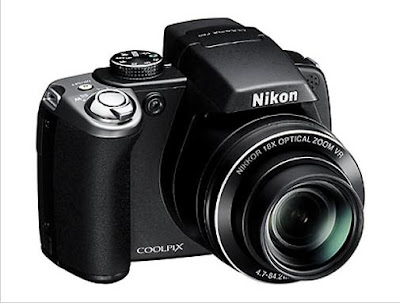
NIKON "ZOOMS" IN ON PERFORMANCE WITH THE NEW COOLPIX P80, AN 18X ZOOM COMPACT CAMERA
MELVILLE, NY (April 10, 2008) - Nikon Inc. is pleased to announce the COOLPIX P80, a high-performance compact camera built to satisfy the needs of camera enthusiasts and family photographers alike. The P80 harmoniously integrates a 10.1 megapixel CCD image sensor with Nikon's innovative EXPEED digital image processing concept and an 18x optical Zoom-NIKKOR lens designed with the compact and comfortable styling of the Nikon COOLPIX brand.
"The COOLPIX P80 addresses a need from consumers for an ultra-zoom compact camera that offers unrivaled Nikon performance and clarity," said Bill Giordano, General Manager Marketing, COOLPIX for Nikon Inc. "Nikon is proud to continue delivering the highest quality imaging products for photo enthusiasts and aspiring photographers with a broad range of creative control options and superior imaging ability."
Packing the power of 10.1 megapixels, the P80 captures fine detail with the creative freedom to crop and edit. The P80 features Nikon's legendary NIKKOR optics, ensuring quality images even while at a distance to subjects. The P80's 18x Zoom-NIKKOR lens covers focal lengths from 27-486mm (35mm format equivalent). To ensure steady shots while utilizing the camera's versatile zoom capabilities, the COOLPIX P80 is equipped with Optical Vibration Reduction (VR).
In line with other COOLPIX P-Series cameras, the P80 includes intuitive controls via dedicated command and mode dials, providing easy access to shooting controls and exposure mode settings. The P80 offers Programmed Auto [P], Shutter-priority Auto [S], Aperture-priority Auto [A] and Manual [M] modes granting users the ability to tap into the creativity of D-SLR functions while maintaining the simplicity of COOLPIX functionality. What's more, the P80 has the benefit of an all-new Sport Continuous Mode, allowing users to shoot as many as 30 consecutive pictures at four, six, or a quick 13 frames per second.¹
Capturing photos in lower light conditions is no problem for the P80. With a light sensitivity range up to ISO 6400², users can now create new opportunities to capture more natural-looking photos with minimal light, or fast moving subjects with unparalleled clarity.
Composing and reviewing photos is an enjoyable experience on the large, 2.7-inch LCD monitor with anti-reflection coating, wide viewing angle and 230,000 dots of high resolution. An eye level electronic viewfinder is available for quick easy viewing in challenging lighting conditions.
The P80 also offers quick access to a selection of 15 different scene-optimized and movie modes including the ability to shoot pictures in both black and white and color simultaneously. The new graphical user interface has an enhanced pop-up design allowing for more precise menu navigation and interaction.
Source: http://gizmodo.com/378064/nikon-enters-super+zoom-race-with-18x-coolpix-p80Labels: Camera Reviews |
| posted by Raisa @ 10:02 PM |
|
|
|
| Friday, January 4, 2008 |
| Review on Sony Cyber-shot DSC-T100 (silver) |

The latest in a long line of stylish cameras, the Sony Cyber-shot DSC-T100 shares the same slim, metallic profile and signature sliding lens cover/power switch as the rest of the Cyber-shot T-series. Don't let the DSC-T100's pretty face fool you, though; this handy shooter proves that you can have plenty of substance with your style.
The camera's easily pocketable, all-metal body measures just 0.875-inch thick and weighs a bit more than six ounces. It comes in silver, black, and red, so you can have your choice of colors. Despite its sensibly laid out controls, the DSC-T100 still sacrifices some of its function for form; the camera's buttons feel smaller and more shallow than I would like and can be a bit tricky for large thumbs. A surprisingly strong heart beats beneath the DSC-T100's slim, shiny exterior. The 8-megapixel camera features a 35mm-to-175mm-equivalent 5x zoom Zeiss lens, a notable upgrade over previous T-series cameras' 3x zoom lenses. Its 3-inch screen supplies an extremely wide view; the display stays clear and colorful, even when looking at it from a near-90-degree angle in any direction. The T100 uses Sony's Super SteadyShot optical image stabilization and can boost its sensitivity to as high as ISO 3,200 for low-light and high-speed shooting. The camera also features a 9-point autofocus mode, an extremely useful feature normally found on much higher-end cameras such as digital SLRs. The Sony Cyber-shot DSC-T100's firmware offers almost as many useful features as its hardware does. Its face-detection mode automatically adjusts exposures when shooting family photos. You can also tweak color, correct red-eye, and even apply different effects such as fish-eye and cross filter, all within the camera. The T100 can also output MP3-playing slide shows to standard definition TVs with the included RCA video cable, or to high-definition TVs with an optional component-video cable. It also works with Sony's CSS-HD1 Cyber-shot Station, a dock with a remote and HD component output support. If you plan on viewing your photos on an HDTV, we highly recommend the component cable or dock option. In CNET Labs' tests, the DSC-T100 performed exceptionally well. After a quick 1.1-second start-up time, the camera rattled off a new shot every 1.4 seconds. With the flash enabled, however, that time ballooned to almost 3 seconds; the tiny 3.4 watt-hour battery simply can't recycle faster. The shutter responded quickly, lagging just 0.4 second with our high-contrast target and 1.2 seconds with the low-contrast one. The camera's burst mode also worked admirably, snapping 15 shots in 6.6 seconds for a frame rate of 2.3 shots per second. The DSC-T100 takes great-looking photos with plenty of detail. Pictures stay sharp and free of noise as high as ISO 400. ISO 800 and ISO 1,600 produce a notable amount of detail-softening, speckled noise but are still useable. The T100's macro and super-macro modes really impress me; it took some beautiful close-up shots of flowers at the Brooklyn Botanical Garden. The camera's pictures aren't perfect, however. Like most snapshot cameras, shots taken at ISO 3,200 look more like expressionist paintings than photos. We recommend you stick to shooting at ISO 800 or lower to avoid extreme noise. Movies captured in Fine mode (640x480 30fps MPEG-4) look very good, as long as the motion doesn't get too complex. A couple of flowers waving in the breeze works, but an entire tree full of fluttering leaves taxes the compression algorithm too much, leaving the video rife with blocky MPEG artifacts. Unfortunately, the trade-off leaves the video file size rather large: at about 1.3MB/sec, a minute of video takes about 77MB of disk space. That's more efficient than the MJPEG used by the Canon PowerShot SD750, but overall still fairly large. The optical zoom operates in Movie mode, another plus. Reviewed by: Will Greenwald Source - http://reviews.cnet.com/digital-cameras/sony-cyber-shot-dsc/4505-6501_7-32329621.html?tag=pop Labels: Camera Reviews |
| posted by Raisa @ 1:37 AM |
|
|
|
| Saturday, December 22, 2007 |
| Review on Samsung L830(RED) Digital Camera |
Up to ISO 200, the camera took 2.8 seconds between shots with the flash disabled. At ISO 400 and above, that wait increased to 4.5 seconds. Most point-and-shoot cameras activate their noise reduction algorithms around ISO 400, so a slight increase in shot-to-shot time is understandable since the camera needs extra processing time. If you mostly shoot in automatic mode, you won't experience this issue; the automatic mode keeps sensitivity at ISO 200 or lower. If you like to shoot in high-speed and high-sensitivity modes, though, you can expect a much longer wait between shots.
In our other performance lab tests, the L830 showed mostly average results, though its time between shots with the flash enabled is longer than we'd like to see. It took 2.7 seconds from power-on to capturing its first shot. The shutter lagged 0.5 second with our high-contrast target and 1 second with our low-contrast target. At ISO 200 and lower, the camera took 3.7 seconds between photos with the onboard flash enabled. Finally, the L830 captured nine maximum-resolution shots in 7.8 seconds for a rate of 1.2 frames per second.
Despite the extra time the L830 takes trying to reduce noise at ISO 400 and above, it doesn't help much. Fine details, such as small text become blurry smears and heavy grain still washes over the pictures. Photos look much better at ISO 200 and below, though fine details still appear slightly soft. The L830's pictures generally look good enough for e-mailing and Web sites, but you should be careful when making prints; pictures shot at ISO 200 or below might look OK at sizes up to 8x10 inches, though ISO 400 or higher shots shouldn't be blown up beyond 4x6 inches. Besides noise and softened details, the L830 suffers from significant barrel distortion when shooting at the wide end of the lens. On the bright side, the camera reproduces colors well, and they stay intact up to ISO 800. At the camera's highest sensitivity of ISO 1,600, colors predictably become washed out, though at that level you won't see enough detail for that to really matter.
The Samsung L830 offers a strange mix of photographer-friendly controls, middling performance, and disappointing picture quality. Its slow shooting and poor pictures at higher sensitivity settings seriously hurt the camera's flexibility, but its generous set of manual exposure and color controls give you plenty of ways to tweak your low-ISO shots. Considering its scant price tag, the L830 offers a lot of camera for experienced, budget-minded photographers. If you ever need to shoot at ISO 400 or higher, though, look for another camera. The older Samsung S850 includes full manual exposure controls including aperture and shutter priority, and it offers slightly better performance and picture quality than the L830. If you're willing to go for a larger camera, Canon's PowerShot A570 IS is around the same price and has a 4x optical zoom lens as well as manual and aperture- and shutter-priority modes. Meanwhile, Sony's Cyber-shot DSC-W55, also in the same size and price range as the L830, trumps this camera in terms of shot-to-shot times and has an optical viewfinder.
Reviewed by: Will Greenwald
Source - http://reviews.cnet.com/digital-cameras/samsung-l830-red/4505-6501_7-32554738.html?tag=pdtl-listLabels: Camera Reviews |
| posted by Raisa @ 1:03 AM |
|
|
|
| Thursday, December 20, 2007 |
| Review on Canon PowerShot A720 IS |
Canon knows not to fix what isn't broken. Last year's PowerShot A710 IS impressed us with its broad suite of features, solid design, and good value. The 8-megapixel PowerShot A720 IS does little to change that formula, sticking very close to the path traveled by the A710 IS.
Save for a few internal upgrades, the A720 IS stands nearly identical to its predecessor. Both cameras share the same 35-210mm equivalent, f/2.8-4.8 lens, the same optical image stabilization, and the same 2.5-inch LCD screen. The A720 IS even shares its predecessor's physical design, right down to the placement of the buttons. The A710 IS' grip featured a rubberized texture that this new version lacks, but otherwise you would be hard-pressed to distinguish between these two cameras at a glance.
Fundamentally, the only changes the A720 IS offers over the A710 IS are its new sensor and image processor. The camera's 8-megapixel CCD can reach ISO 1600, beating its older brother's limit of ISO 800. The camera uses Canon's Digic III image processor, an upgrade over the older Digic II processor that offers face-detecting autofocus and autoexposure, an increasingly common feature that helps when framing portraits and family photos. Besides those upgrades, it might as well be the same camera as the A710 IS.
Fortunately the A710 IS worked so well that the A720 IS really doesn't need to change that much. Like its predecessor, this chunky new camera puts function over form, with large, accessible buttons and a solid, grippable body design. The A720 IS weighs a hefty 8.6 ounces with batteries and SD card--just 0.4 ounce less than the A710 IS. Like its older brother, the A720 IS features a full selection of manual exposure controls, including program/aperture/shutter/manual modes readily accessible through the camera's mode dial.
Reviewed by: Will GreenwaldLabels: Camera Reviews |
| posted by Raisa @ 12:55 AM |
|
|
|
|
|